history

Home
Database
Our
Purpose
Library


Other
Resources

News
Research
Shopping
History
of Duchess
DF Founders Circle
Disclaimer
Awards
Add
Records of Your Pet Pig to DF

Case
Histories
Paying
Respect in Dollars and Sense
Contact
Us
Now Available New Video!

The
medical procedure video we have all been
waiting for is now available for purchase!


This video includes neuters, spays, blood
withdrawal, hoof trim, tusk trim, and
entropion.


All for just $59.95!


Click
Here For More Info!


Donations To The Duchess Fund Are Welcomed


The Duchess Fund
Duchess of Pork, a
registered, purebred potbellied pig, was the
perfect pet and loved very much by her family of
three and three other potbellied pigs. Duchess
was a special pig and exceptionally bonded to her
owners. She was also a deaf pig. She suffered
from intermittent seizures for a year before she
finally succumbed to liver disease in May,
1999. 


The Duchess of Pork

The Duchess of Pork Memorial Services

She was
barely two years old at the time of her death.
The extensive diagnostic work-up (x-rays,
sonograms, endoscopy, blood work) and subsequent
necropsy and histopathology report all seemed to
raise more questions than answers. Despite having
access to the latest medical technology and
drugs, veterinarians were relatively helpless in
their efforts to arrest or reverse her
deteriorating condition. Since no precedent had
been set from any previous cases, the medical
staff who worked with Duchess was truly entering
new territory. The need for The Duchess Fund was
obvious.

Duchess is not
alone. Many other potbellied pigs die before
their time. She is but one example of many.
Veterinary medicine providers have little
literature to guide them in the advanced care of
companion pigs. Even though potbellied pigs have
been popular as pets for years, most veterinary
schools still offer little, if any, training in
the care of miniature pet pigs.


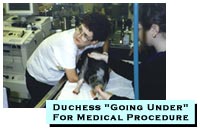
Duchess "Going Under" for a medical procedure.

When
confronted with an illness in a pet pig, a
veterinarian will have to use his/her best
judgment in combining small animal and swine
diagnostic and therapeutic techniques and then
modifying them to reflect observable differences
such as weight and size. Many practitioners who
have cared for a number of these animals suspect
that there are other as yet unrecognized factors
that may mandate a course of care different from
what is currently known. Even if current
therapies are fully adequate, the limited data
results in the practitioner taking a conservative
approach, and watching carefully for
unanticipated side effects specific to the breed
or individual. Such an approach may not always
yield the best long term outcome. More aggressive
therapies are not prudent unless there is much
better data available as to the probable impacts
(both positive and negative) of various
approaches.

Duchess of Pork Memorial Services
SEPTEMBER 9, 2000,
ROSS MILL FARM, RUSHLAND, PENNSYLVANIA

BY: BARBARA BAKER

Our trip to
Pigstock began on Friday, September 8th when four
of us flew to
Pennsylvania (my husband, Bob, and Janie and Bob
Finck). We arrived at Ross
Mill Farm in the afternoon and spent the rest of
the day and evening with
"pig" friends.

The
Memorial Service for Duchess began Saturday
morning about 9:45 AM and
was attended by a couple of dozen people.
Lulabelle (mother of Duchess) was
wearing her harness laced with fresh flowers for
the occasion. Everyone
attending was given fresh flowers to hold and
carry.

Susan
Armstrong led the way with Lulabelle by her side.
We proceeded to the
edge of the woods where Duke and Duchess used to
romp, play and nap as young
piglets. "Trumpets Voluntary" played
from the Gazebo as we walked to
Duchess’ favorite "playground".

Once
there, I was surprised by a tripod with something
on it covered up by a
sheet. I wondered what was under the sheet. Susan
spoke first about
Duchess as she scattered some of her ashes,
followed by Richard Magidson,
Janie Finck, Bob Baker, me and Colleen Nicholson.
Colleen read the story of
Duchess’ short life as communicated to Colleen
from Duchess. There wasn’t a
dry eye to be found.

Next came
the unveiling of the contents under the sheet.
Much to my
surprise, Becky DiNolfi had painted a large
portrait of Duchess as a piglet!
It is gorgeous! I wasn’t even aware that Becky
could paint! Then the real flood came.

The ashes
scattered, words spoken, tears shed, we
progressed back to the
main house and I took the portrait into the
General Store to be displayed
there for others that would be arriving later.
Here I spent some time
alone with the portrait.

I printed
up cards for the occasion with a large golden
"D" on the front

surrounded by colorful flowers. Inside it read:

IN LOVING
MEMORY OF DUCHESS OF PORK

MAY 5, 1997 – MAY 28, 1999

MEMORIAL
SERVICE, ROSS MILL FARM

SEPTEMBER 9, 2000 FOR THE SCATTERING OF SOME
ASHES

THE
DUCHESS EXPERIENCE – A SEGMENT – HER WORK IS NOT
DONE

NEITHER "HERE" NOR "THERE".
HER WORK WILL BE CONTINUED

"HERE" BY THOSE WHO PERCEIVE TO HAVE
BEEN ENTRUSTED

WITH IT. ONLY DUCHESS KNOWS WHO WILL BE HELPING
HER TO

CONTINUE HER WORK "THERE".


Duchess' Care - The Vet's Perspective

BY: DR. NEIL SHAW,
DVM

Duchess
Of Pork initially presented to me for evaluation
of seizure activity. As a small animal internist,
I approached the case with an open mind and with
the basis of a basic understanding of disease
mechanisms. I quickly appreciated a lack of
precedent and data in the intensive medical
management of the ill pig for the reason of
emotional attachment rather than commercial
production. I have no special expertise or
experience in porcine medicine.

The
differential diagnoses for seizures can be broken
down into categories, specifically congenital,
inflammatory, metabolic, toxic, nutritional,
traumatic (vascular) and neoplastic disorders.
The cause of seizures can be difficult to
diagnose. One is often left to make a diagnosis
by rule out, in which the most likely diagnosis
is selected by disproving other causes. A solid
client history rules out nutritional, toxic and
some traumatic causes. A basic medical database
(CBC, serum chemistry panel, urinalysis, and
radiographs) would rule out metabolic causes. If
the cause of seizures is not nutritional,
traumatic, toxic or metabolic, then it is likely
to be located in the brain. Advanced testing to
rule out the remaining differentials include
analysis of the cerebrospinal fluid (CSF) and a
scan of the brain (MRI or CT scan).

Duchess’
initial bloodwork revealed evidence of
significant liver insufficiency. The end products
of hepatic metabolism (albumen, glucose and urea
nitrogen or BUN) were low. Bilirubin, a product
of body metabolism that is consumed by the liver,
was elevated. These findings indicate and
inability of the liver to meet the body’s needs.
The presence of elevated liver enzymes indicated
active liver inflammation (or hepatitis).

If the
liver does not work efficiently then it is unable
to metabolize protein. Ingested protein is
normally converted in the liver from ammonia to
urea. In cases of liver failure the ammonia
remains in the bloodstream and may act on the
brain as a false neurotransmitter. The result
could include dementia and seizures (hepatic
encephalopathy). Hypoglycemia (low glucose
levels) may also cause seizures.

Although
there was clear evidence of liver failure, the
presence of active inflammation was actually
encouraging. If the active inflammation could be
treated then the liver would have the opportunity
to regenerate. The potential causes for hepatitis
in this case included bacterial, viral, parasitic
and immune-mediated etiologies.


Duchess was placed on several medications.
Enrofloxacin (Baytril) and amoxicillin are
antibiotics designed to cover a broad spectrum of
bacterial infections. Ursodeoxycholic acid
(Ursodiol) was used to promote bile flow through
the liver. Lactulose was prescribed to decrease
the absorption of protein (in the form of
ammonia) from the intestines. Metoclopramide
(Reglan) was used to counteract nausea.
Famotidine (Pepcid-AC) was prescribed to decrease
gastric acid secretion. Ivermectin was
administered to rule out parasites and sweet
treats such as gummy bears were added to help
maintain blood glucose levels. Later,
chlorpromazine was added on an as needed basis as
a stronger treatment for nausea.

Abdominal radiographs and ultrasound appeared to
reveal evidence of a small liver for the body
size, in comparison to other species. Ultrasound
also revealed evidence of inflammation within the
wall of the gallbladder. Unfortunately, normal
radiographic and ultrasound findings for the PBP
have not been identified. The assessment of a
small liver was not universal.

On medical
therapy, the liver enzymes initially decreased
but then elevated to original levels. The
secondary evidence of liver disease (low glucose,
low albumen, low urea) persisted. A definitive
diagnosis would rely on a liver biopsy.
Unfortunately, we were unable to obtain this
sample, largely due to the small size of the
liver. During a second anesthetic episode, we
were also unable to intubate Duchess to obtain a
safe level of anesthesia in order to perform
endoscopic evaluation of the stomach.

Duchess
died as a result of a seizure resulting in first
respiratory, then cardiac arrest. The potential
causes of the seizure include a low blood
glucose, hepatic encephalopathy, and
complications of anesthesia from the previous
day. The most likely scenario is a combination of
the above three. Necropsy revealed strong
evidence of chronic liver disease. Samples of
multiple tissues have been submitted for
pathology. The final and hopefully definitive
diagnosis will depend on the pathology results.

I would
like to commend Barbara Baker and others for
maintaining a remarkable degree of objectivity
when confronting the illness and ultimate death
of a family member, such as Duchess. The approach
to disease mechanisms in this species is
fascinating to me. However, I am frustrated by
both personal inexperience in the management of
and general paucity of sound data regarding the
pathophysiology of pet pigs. The network of pig
owners as well as a database of the medical
history, laboratory and pathology results would
be a needed and invaluable resource. I hope to
submit a second article to this publication
discussing the final diagnosis on Duchess and
potential implications for the management of
personal pigs.


Neil Shaw, DVM, Diplomat American College of
Veterinary Internal Medicine

Medical Director, Florida Veterinary Specialists

Duchess' Care - The Owner's Perspective

DUCHESS OF PORK HAS
SEIZURES by: BARBARA BAKER May, 1999

Up
until recently, I had never experienced a human
or an animal having a seizure. Duchess began
having seizures a year ago (April, 1998) at about
age 1. Her legs would tremble and she would go
down, unable to walk. These were mild seizures
and very infrequent. As months passed, the
seizures got stronger and her body would quiver
and her snout would pull away from her body as
she lay on her side. In the beginning, she was up
and off again after a few minutes back to her
normal self. I described what was happening to
our vet and he said I was describing seizures. He
said we could do some blood work to attempt to
detect the cause of them or put her on anti
seizure medication if they become frequent and
long lasting enough to warrant the medication.
Often times, the cause is never found. The
frequency seemed to get less in the Fall of 1998
but they started up again before Christmas and
started getting longer and more severe. In
February, she had an extended seizure lasting
over 2 hours and I had to take her into the vets
office for a shot of valium to bring her out of
the seizure. Blood was also drawn so we could
attempt to get to the cause. The results showed
abnormalities in the liver function.

Following
this she was referred to Florida Veterinary
Specialists where she began treatment by Dr. Neil
Shaw (board certified in internal medicine). The
entire staff of veterinarians at this clinic is
board certified, each in their own particular
specialty. They recently opened up their new
clinic at 3000 Busch Lake Blvd. in Tampa. They
have the equipment and facility to do the most
sophisticated of tests required! Initially, I had
a consultation with Dr. Shaw (March 22nd) about
Duchess and after he reviewed the blood work that
had already been done, he recommended we repeat
the blood work, get some bile acid tests, do some
x-rays, ultrasound and urinalysis (to be done on
April 12th with a 24 hour fast prior). April 11th
rolled around and I must say, fasting a pig for
24 hours while other pigs are eating is the

PITS! I packed her up early the morning of April
12th along with blankets and a host of other
items. I got her unloaded with the help of the
staff at FVS and get her in the exam room and
waited on Dr. Shaw. When he walked in, he
commented that I appeared to be in worse
condition than the pig. Yes, I was a basket case
but I didn’t have any idea it showed that much!!
I picked her up and held her while he gave her an
injection of Valium. She barely moved. I then
carried her to the procedure room where we held
her and Dr. Shaw drew blood. Next I carried her
to the X-ray room where Isoflurane was
administered so the x-rays could be done as well
as the ultrasound. The ultrasound illustrated an
infection in the gall bladder. The blood test
results came back, again, showing liver
abnormalities with elevated bile acid. He said
she was in liver failure. The x-rays were sent to
a radiologist for further interpretation and came
back apparently normal. The x-rays were then sent
to Texas A&M (Dr Bruce Lawhorn) for a second
opinion and came back normal. X-rays have limited
value in evaluating the condition of a liver.
They are best for judging the size and location.
The liver enzymes were still elevated and she was
put on two antibiotics for 10 days and lacktulose
syrup, two ml three times a day. Blood work was
repeated again on April 26th after the
antibiotics were completed. This time, there was
only a 12 hour fast (much easier but still the
PITS!) I, once again, got her unloaded with the
help of staff and got her in the exam room. No
valium was administered so the liver wouldn’t be
taxed. I carried her to the procedure room and
held her on the table with my arms around her
girth and an assistant had their hands on her
rump so she couldn’t back up. Duchess was such a
good patient. She "sat" there and never
made a sound while the blood was being drawn from
her front leg by Dr. Shaw. I then carried her
back to the exam room and fed her the breakfast
she missed out on earlier in the day. When the
results were back that afternoon, the liver
enzymes were elevated even more. I was
devastated. On April 30th, I loaded her up again
(another 12 hour fast) and a repeat ultrasound
was done which indicated the gall bladder
infection had cleared up with the antibiotic
treatment. An injection of Ivermectin was given
to rule out internal parasites (and repeated
orally 10 days later and 7 days later by me).

Beginning
on May 3rd, her medications were as follows:

Lactulose
10 gm 2 ml orally three times a day

Amoxicillan 200 mg. 1 tablet every 12 hours

Enrofloxacin 22.7 mg. 1 tablet every 12 hours

URSODIOL 250 mg. 1/4 tablet twice daily (May
cause nausea)

Metoclopramide 5mg 1 tsp. three times daily (this
was added on May 6th

due to nausea)

She could
also have Pepcid AC every 12 hours.

She was
taken off the URSODIOL after a few days due to
nausea. However, the nausea and sleeplessness
continued and stomach ulcers were strongly
suspected. She was given Chlorpromazine at
bedtime to treat the nausea and help her sleep
(short term medication only).

Some of
these medications have side effects and one is
nausea. At least one of them is very bitter so I
placed the pill inside peanut butter and then
froze them and then placed them inside of yogurt
on top of her pellets. One morning, half way
through her breakfast, she stopped eating and put
her bristles up and started making little
"woof woof woof" noises at her bowl.
She quit after a minute or so and continued to
eat. She certainly was telling that food
something (maybe to quit making her sick!!!).

I cannot
stress how fortunate pet owners are to have the
Florida Veterinary Specialists here in our area.
People bring their animals from all over the
country to this clinic. It has given me a
tremendous sense of relief having her tests and
treatments done by Dr. Shaw and his staff. I have
been with her throughout every procedure which
lessened the stress on Duchess. She is deaf and
very dependent upon me. Treating potbellied pigs
continues to be a challenge due to the lack of
medical case histories and a medical data base
for them. I have launched a national seizure
questionnaire so that we can collect medical
history to better equip us to treat potbellied
pigs of the future that are experiencing
seizures. The questionnaire appeared on the front
page of NAPPA NEWS and is appearing in some
national potbellied pig magazines as well as pig
club newsletters across the country. Thanks to
everyone that is cooperating with this effort!!!!

I spoke
personally with Dr. Bruce Lawhorn of Texas
A&M (who heads up a swine research farm
there) and Dr. Oliver Duran of Michigan State,
another swine expert. They both confirmed that we
are entering new territory here. Dr. Duran said
most of his work relates to swine production
(where the $ is) and no individual sow or boar is
valuable enough to warrant these sophisticated
tests be done….after all, slaughter is on their
agenda.

Interestingly
enough, the last seizure Duchess had was March
31st and it was about a minute in length and very
mild.

Update:
5/29/99. Blood work was repeated on 5/27/99. I
was encouraged because two liver enzymes had
dropped approximately 50% but after talking to
Dr. Shaw my encouragement soon waned. The
remainder of the results remained the same
indicating liver failure. In the event the immune
system was attacking the liver, steroids would be
given next but this treatment comes with a host
of side effects. The day after her blood work was
done (Friday, May 28th), she started tilting her
head and going down on her side and
"wiggling" then getting back up again.
She was very restless and disoriented. I phoned
Dr. Shaw and said to bring her in immediately.
Upon arrival, he felt that she needed to be put
on IV to flush her body out for 24 hours. This
probably was from toxin buildup because of the
insufficient liver function. He phoned Dr. Bruce
Lawhorn at Texas A&M and Dr. Lawhorn also
agreed that the "IV flush" was needed.
They also discussed her entire medical history,
prognosis and future treatment plans. She was
admitted to ICU and was given an injection of
valium to calm her for later insertion of the IV
in her ear. I left the clinic to drive my husband
back to his office and while driving, Dr. Shaw
phoned me on my car phone to inform me that she
went into a massive seizure followed by
respiratory failure and they were unable to
resuscitate her. I requested a necropsy be done
and he phoned me later that afternoon to report
that the liver was small, shriveled and hard and
appeared to be degenerating. The gall bladder was
enlarged with debris in it. There were small
ulcerations inside the stomach wall. There was
fluid in the abdomen which was secondary to low
proteins. It was all consistent with massive
liver failure. Pathology reports and a written
necropsy report will follow. Florida Veterinary
Services made the arrangements for cremation and
having the ashes deposited into an urn for us.

I’d like
to thank everyone from coast to coast for their
support, friendship and compassion throughout
this ordeal. Duchess was loved by everyone that
ever met her and many that never met her.

In her
honor, I would like to establish a Duchess
Memorial Fund for pigs in the future. It is my
desire to set up an interest bearing savings
account with no service charge where these funds
can be deposited. Ideally, an advisory board will
be appointed to evaluate the cases whereby funds
would be released for future necropsies and other
diagnostic lab work. The mechanics of this will
be worked out in the days to come. Medical
histories and a medical data base for potbellied
pigs needs to be established in conjunction with
this effort.

Duke
doesn’t know life without Duchess (littermate
brother) and he worshipped the ground she walked
on. He would lay with her as if to protect her
should the larger two pigs "pick on
her". Duke has some difficult days ahead of
him to adjust life without her as we all do.

THE
DUCHESS EXPERIENCE – A SEGMENT. 

HER WORK
IS NOT DONE NEITHER "HERE NOR
THERE". 

HER WORK
WILL BE CONTINUED "HERE" BY THOSE WHO
PERCEIVE TO HAVE BEEN ENTRUSTED WITH IT. 

ONLY
DUCHESS KNOWS WHO WILL BE HELPING HER TO CONTINUE
HER WORK "THERE".


AGAIN,
THANKS TO:

FLORIDA
VETERINARY SPECIALISTS – DR. NEIL SHAW

3000 BUSCH LAKE BLVD.

TAMPA, FL 33614

813-933-8944


ABOUT FLORIDA VETERINARY SPECIALISTS:

They are a
state-of-the-art regional veterinary referral
center and provide specialized referral services
as well as emergency and critical care, 24 hours
a day. Their practice operates strictly by
referral from the family veterinarian. They offer
a full range of diagnostics and treatments in
Internal Medicine, Cardiology and Neurology as
well as Dermatology, Oncology, and Surgery. They
have the only veterinary designated linear
accelerator in Florida for radiation therapy.
They provide orthopedic surgical procedures as
well as soft tissue and neurologic surgical
procedures including CSF taps, myelograms and
intervertebral disk protrusions. They provide
consultation on complex medical cases including a
full range of diagnostics and treatments
including ECG, Radio-iodine (I131), Oxygen
therapy and blood gas determination, ultrasound,
endoscopy, contrast radiography, CT scans and MRI
access. Hotel accommodation information is
available for out-of-town clients.


Visit their website at: http://www.F-V-S.com
or email them at FVS1@aol.com

 A Poem for Duchess

Do
not stand at my grave and weep,

I am not there, I do not sleep

I
am a thousand winds that blow,

I am the softly falling snow.

I am the gentle showers of rain,

I am the fields of ripening grain.

I
am in the morning hush,

I am in the graceful rush

Of beautiful birds in circling flight.

I am the star-shine of the night.

I
am in the flowers that bloom,

I am in a quiet room.

I am in the birds that sing,

I am in each lovely thing.

Do
not stand at my grave and cry,

I am not there _

I did not die.


For anyone
that has lost a beloved pet, you may find comfort
in visiting the following website: http://www.petloss.com

You can
also contact your veterinarian for a local pet
loss support group in your area.

Personal:

Resides in Ruskin, Florida with her husband, Bob,
her son, Armand, and their four potbellied pigs,
Lady Lee, Lord Chapman, Duke of Earl and Princess
Grace. Barbara and Bob got their first potbellied
pig in 1991.

Background:

1992-present Pillar Pigs of the Community, a
Tampa Bay area potbellied pig club that has
quarterly meetings and publishes a quarterly
newsletter, assists pet pig owners with care,
feeding and medical issues as well as
rescue/adoptions.


1994-2000 Secretary of the North American
Potbellied Pig Association.

President:

Lobbies with state and local government on pet
pig issues.

Meets quarterly and publishes quarterly
newsletter.

Assists pet pig owners with care, feeding and
medical issues as well as rescue/adoptions.

Accomplishments:


Recipient- PET PIG HERO OF THE YEAR award,
January 2000, by PIGS AS PETS ASSOCIATION at the
annual conference held in Ft. Myers, Florida.


Established the first law in the country to
regulate potbellied pig breeders- Hillsborough
County, Florida.


Helped State Health Veterinarian establish pet
pig rabies protection guidelines for Florida
(first in nation).


National conference speaker, last two years.


Author of numerous articles on pet pig care and
issues.


Appears frequently in TV news stories.


Upcoming feature for Animal Channel: PETS PART OF
THE FAMILY.


Nominated for Hillsborough County’s 9th Annual
Moral Courage Award for committed service to the
community pertaining to pet pigs.


Recipient HAPPY HOG AWARD 1999 by Florida Voices
for Animals for untiring work in Hillsborough
County for the benefit of pet pigs.


Upcoming feature for Animal Planet (Pet Project)
on potbellied pigs as pets and medical
requirements.


Pillar Pigs recipient from the SPCA of Pinellas
County, Florida for devotion to the pigs of the
community.

"Chloe’s
Garden is a virtual memorial for pet pigs who have crossed The
Rainbow Bridge. You can place your pig in the garden by going
to http://www.chloesgarden.com
and clicking on the "Join Chloe" link."
 

The
Duchess Fund
408-14th St. S.W., Ruskin, FL
33570 USA

Ph: (813) 641-3013
Fax: (813) 645-1625 E-mail:lordsmom@tampabay.rr.com

Copyright ©2000-2006 The Duchess Fund. All Rights Reserved.

This site is maintained by Webfoot.Net.
We may be contacted at webmaster@webfoot.net.